Thursday, 9 January 2014

Starfish Dissection


This was my starfish. It reddish, brownish colour. It had a rough texture on the top because it has spiny skin. The top surface seen in this picture is called the aboral surface. The five points or arms seen in this picture are called radial arms.

That light brown spot in the middle is called the madreporite, which is used for water intake.

This is the bottom side of the starfish. It is also known as the oral surface.

Right in the very center of the bottom side is the mouth of the starfish.

Here on the underside of its arm, the purple coloured, spongy-looking things running down the middle, are called tube feet.

After cutting the arm open, one can see the digestive glands, also known as pyloric ceaca.

The orange thing seen on both sides of the white line has ampulla on it.

That brown stuff on the end of the probe is called the gonad.

This dissection surprised me because I did not expect a starfish to have so much brown stuff in it, I always imagined it to be all red. One question I have about starfish is, how do starfish move?

Wednesday, 8 January 2014

Grasshopper Dissection

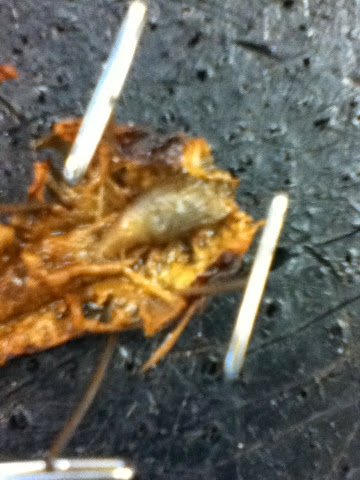
My grasshopper was a male because it did not have an ovipositor on the end of the abdomen. Also it had no ovaries inside. 

In this photo you can see the head of the grasshopper, along with its antennae and compound eyes.

In this photo you can see the thorax, the segment after the head, which is where the legs are attached.

After the thorax is the abdomen (the long part). There are eight segments on the abdomen.

The grasshopper had six legs, four normal legs for walking and two big legs in the back for jumping.

This is one of the jumping legs. The thickest part of it (the "thigh") is called the femur. The thinner part is called the tibia.

This "foot" is called the tarsus.

Here are the wings.

This is the inside of the grasshopper. The big, brown lump at the top is the crop. The area of this lump where it gets light brown is called the gizzard.

After the gizzard come the stomach and the intestine.

Anwser to LAST QUESTION:

Since I dissected this grasshopper I am curious to see its brain. That was the one thing I did not see. Also, its heart.

Tuesday, 7 January 2014

Black Widow Spider


This is the Black Widow spider. It belongs to the phylum arthropoda. These spiders are usually identified by the red, hourglass-shaped mark on their abdomens. One weird thing about this species, is that sometimes, after mating with its male counterpart, the female Black Widow spider kills and eats the male. Hence the name. Some of the many bugs that Black Widows prey on are grasshoppers, flies, beetles, and caterpillars. This spider is actually quite dangerous. Its bite is found to be venomous. Infact, its venom is reported to be 15 times stronger than that of a rattlesnake! Although fatalities from this bite are rare in humans, there are symptoms such as nausea, muscles aches, and a paralysis of the diaphram which can make breathing difficult. These bites are mostly fatal for small children, and elders. Fortunately, Black Widows are non-aggressive, and mostly bite in self-defense. Insects have a higher risk of being killed by Black Widows.

The fact that Black Widows are so dangerous, because of their venomous bites, is the reason why these spiders are so successful. Not many animals try to challenge this species. It does not have many predators. It is quite feared. The Black Widow spider is considered to be the most venomous spider in North America.

Black Widows are not really helpful, but they are not exactly harmful either. They don't tend to get in the way too much. They only attack humans when they feel threatened. Although, sometimes this species aids in getting rid of pests that harm crops.

More Information:

Video showing a female mating with a male, and then eating it:
   

Tuesday, 17 December 2013

Roundworm Dissection


This is the roundworm I had for my dissection and it is a male. I know it is a male because of the "hooked" side of it, shown above.

This is when we had it dissected and those squiggly, spaghetti-looking things you can see inside it, is its testes.

That flat, ribbon-like thing sticking out of it is its intestine, through which its food goes.

Thursday, 12 December 2013

Porifera


These are some examples of the many sponges that inhabit the ocean. All these sponges are actually not plants, they are animals! Sponges are categorized in the phylum called Porifera. Porifera meaning, an animal with holes. I will be talking about the seven essential functions in an animal, regarding sponges:

1. Feeding: Sponges are filter feeders. The reason they have holes in them is so the water can constantly flow throughout their whole body, so that they can obtain food and nutrients by filtering the water. Sponges mostly feed on bacteria and food particles that flow in the water.

2. Respiration: Sponges respire (receive oxygen) when the water flows through their holes. The type of respiration that sponges use is called osmosis. The water flows in through their pores and once the filtering is done, the water leaves the sponge through the osculum (the main hole on the top).

3. Circulation: Sponges have no circulatory system. They do not have any specialized techniques to transport oxygen, food, and nutrients throughout their bodies. Instead, the water flow through the holes cover for this. The circulation of the water gets food and nutrients in the sponges. 

4. Excretion: Sponges do not have an excretory system either. But, sponges do remove mineral particles that threaten to block the ostia. Archeocytes transport them through the mesohyl and dump them into the outgoing water current. Once again, they use the flow of water to remove wastes.

5. Response: Sponges do not have a nervous system. They do not have nerves or anything like that. However, strangely, sponges do react to stimuli.

6. Movement: Sponges do not have proper skeletons, but they do have something called a mesohyl, that functions as an endoskeleton. It is the only skeleton in sponges that encrusts hard surfaces such as rocks. Sponges do not move, they normally just stay in one place. But, this is for adult sponges. Juveniles are motile. Adult sponges do not move, however, there are some sponges that move 1-4mm per day, because of amoeba-like movements of pinacocytes and other cells.

7. Reproduction: Sponges are neither male nor female. Sponges can reproduce sexually and asexually. Asexual reproduction requires only one parent, and it is done by budding. This is when a piece of a sponge breaks off and forms an entirely new one, that is identical to its parent. For sexual reproduction, a "male" sponge releases sperm that flows in the water until it finds another "female" sponge of the same species. The sperm then enters the sponge through its outer pores, where it will fertilize the egg. The egg will turn into larvae that will eventually attach itself to the ocean floor and grow into an adult.  

Wednesday, 11 December 2013

Tapeworms


Tapeworms are from the phylum Platyhelminthes and tapeworms are parasitic flatworms from the class Cestoda. These tapeworms from the class Cestoda generally live in the digestive tract of vertebrates as adults and they are often in the bodies of many different animals as juveniles. The tapeworm has a long, flat body made up of a head, a neck, and a chain of segments, or sections. A chain can be made up of 3 to more than 4,000 segments and range in length from less than one inch to more than 75 feet. Tapeworms have no digestive system. They absorb food through their body walls directly from the host's intestine. Symptoms of tapeworm infections are not easy to detect. Because of this, infections are often not detected at all. Most of the time there no symptoms. Sometimes there is abdominal pain, nausea, diarrhea, and more, but not quite often. To get rid of tapeworms, you can kill them using drugs that don't harm the host.

For more information, go to:
http://animal.discovery.com/worms/tapeworm-info.htm

Monday, 9 December 2013

Plant Photo Journal

Mosses:


The environment in which I found these mosses was a damp, cold, kind of wet environment. There was water nearby too. It was a place that would have a lot of water left after it rained. Mosses need to live in these moist environments because they need a lot of water. They need a lot of water because they have swimming sperm that needs water to swim through, in order to get to the egg. Also, mosses are non-vascular, meaning they do not have special tubes that transports nutrients and water throughout the whole plant. This is why mosses live in wet environments, they need direct water. The fact that they are non-vascular is why they grow close to the ground. They lack the vascular tissue (the tubes) needed to get water and nutrients to the cells high above ground. Mosses can grow on rocks because they can grow anywhere that is moist, or wet. Also, mosses do not have roots that anchor into dirt. Mosses have rhizoids which are root-like structures that anchor the moss to the ground. They can anchor a moss onto a rock.

Ferns:

This is the underside of the fern shown above. I can see some sori. 


The environment in which I found these ferns was a wet, moist environment, and one of them was actually right beside a little stream of water. Ferns need to live in moist environments because they also have swimming sperm that needs water to swim to the egg. Ferns are different from mosses because they can grow tall, they have big, long stems, and they have proper leaves called fronds. They are vascular. Because they are vascular, they can grow bigger. The vascular tissue transports nutrients and water throughout the whole plant, including high above the ground. This is why ferns can grow big. Their stems support them too, helping them to stay up. Ferns need to grow in soil because they have roots, and these roots anchor into soil, and obtain water and minerals from the soil for the fern.

Gymnosperms:

These are the male cones.

These are the female cones.


These are the male cones.

This is a female cone.


Some adaptations that gymnosperms have that allows them to live in varied environments (such as cold, harsh environments) is their needle-like leaves. These leaves are an adaptation to withstand harsh climates. Also, gymnosperms produce seeds, which are able to withstand droughts and cold temperatures because of their dry, inactive state. Pollination is different from fertilization because pollination is when the pollen grain comes in contact with the female structures of a gymnosperm. Fertilization is when a sperm cell joins with an egg cell, and produces a diploid zygote. The structures involved in pollination are the pollen cones, the pollen grains, and the seed cones. The structures involved in fertilization are the sperm cells, the egg cells, and the pollen tubes.

Angiosperms:
A dicot.

The branched veins on this leaf show that it is a dicot.

A dicot.

The branched veins on this leaf show that it is a dicot.

A monocot (grass).

The parallel veins on this grass leaf show that it is a monocot.

A monocot (corn).

The parallel veins on this corn leaf show that it is a monocot.

Angiosperms are well adapted to life on land because they have many different strategies to reproduce. They produce pollen which does not need water to get to another plant, it gets blown away by the wind. The fact that angiosperms do not need water to reproduce, is a good reason for a plant to be assumed well adapted to life on land. Angiosperms have other strategies too, like having colorful and scented petals to attract pollinators, in order to disperse the pollen to other plants. Also, angiosperms produce fruit with seeds in them, and these fruits are made for animals to eat, so that later, the animal that eats the fruit will poop out the seeds. If the seeds are in a good place, they will grow another plant. These are some seed dispersal strategies that angiosperms use, and they also show that angiosperms are well adapted to life on land. The purpose of the fruit that is produced from an angiosperm, is that it is a protective covering for the seeds, unlike gymnosperms, which have no protective covering around the seeds. Also, the fruit is produced for seed dispersal (explained above).